
Vision-language-action models: when an AI answer has to move something
Connect instructions to robot actions with observable completion.
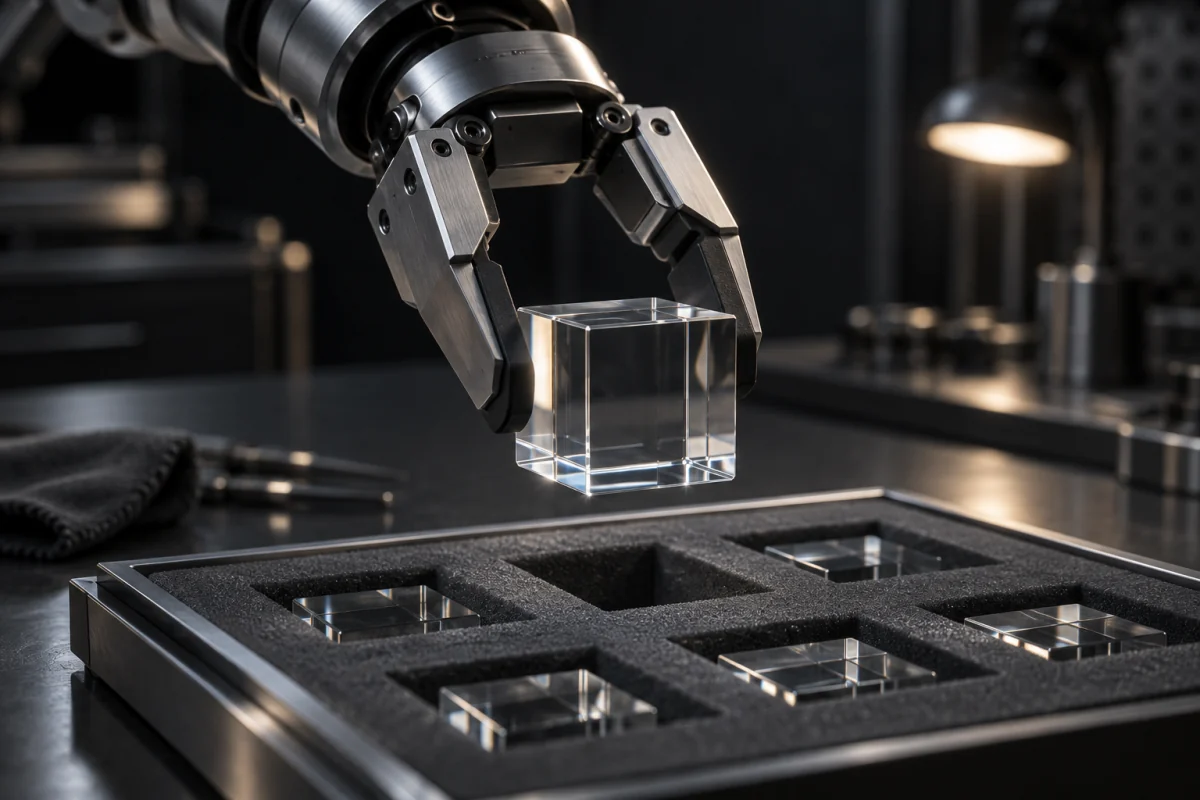
A language model can describe how to place a cup on a shelf. A robot must determine where the cup is, how to grasp it, whether the shelf is reachable, and whether the object remained stable after release. The physical task exposes a gap between describing a successful action and executing one under uncertainty.
Vision-language-action models, often shortened to VLAs, study a connection between visual observations, language instructions, and robot actions. The idea is compelling because language can express goals flexibly while vision supplies information about the scene. The difficult part is turning those inputs into movement that remains appropriate as the scene changes.
Start with a task that has a physical endpoint
Consider a fictional laboratory demonstration in which a robot places a lightweight block into a tray. Success is not simply moving the gripper toward the block. The block must be identified, grasped without slipping, transported within the permitted workspace, and released inside the correct tray. Each stage has observable conditions.
Specify the environment before comparing models: object shapes, lighting, camera placement, robot hardware, and allowed starting positions. A result on one carefully arranged table does not establish reliability in every room. Clear task boundaries make the demonstration more informative because they reveal what has and has not been tested.
Research connects representations across domains
RT-2 investigated transferring knowledge from vision-language models into robotic control by representing actions in a form compatible with the model's output. Open X-Embodiment assembled robotic datasets across embodiments and studied models trained with that broader data. These works provide primary research context for the VLA direction.
Read the original research paper on arXiv
Read the original research paper on arXiv
The practical distinctions below are original analysis. They do not imply that web knowledge alone supplies physical competence, or that a model trained across several robots can operate any new machine without adaptation. Action interfaces, embodiment, and evaluation conditions remain essential parts of the system.
An action representation is a contract with the robot
Actions may be represented as changes in position, orientation, gripper state, or other control quantities. The meaning of each value depends on the robot and coordinate convention. A command expressed relative to the camera is not interchangeable with one expressed relative to the robot base.
Keep the action interface explicit and validated. The model's output should pass through a controller that understands the robot's limits rather than being treated as unrestricted authority over motors. Invalid values, stale observations, and commands outside the permitted workspace should have defined handling. This boundary is part of the application architecture, not an optional prompt instruction.
Visual recognition does not establish graspability
A model may identify a cup accurately while failing to infer whether its handle is reachable or whether the material will slip. Images provide evidence about geometry and appearance, but physical interaction may reveal properties that were not visually obvious. The same object can require different behavior depending on pose, contents, and surrounding clutter.
For the block-and-tray task, separate object identification from grasp success. Record cases where the robot selected the correct block but failed to secure it. This distinction helps the team avoid attributing every failure to language understanding and directs attention toward perception, control, or the physical setup when those are the actual bottlenecks.
Closed-loop behavior matters after the first movement
A plan based on an initial image can become outdated as the robot moves. The block may shift, a gripper may obscure the camera, or another object may enter view. A closed-loop system observes the consequences of actions and adjusts rather than executing a long sequence on the assumption that every earlier step worked.
Choose observation and control rates that fit the task and hardware. A high-level model can propose goals while a lower-level controller handles rapid adjustments. The division should be tested as a whole. A strong visual model does not compensate automatically for slow feedback or a control layer that cannot respond appropriately to contact.
Demonstration data carries hidden assumptions
Robot demonstrations include more than successful trajectories. They encode camera viewpoints, operator habits, starting states, and the range of mistakes that appeared during collection. If demonstrations always begin with an unobstructed object in the center of the table, the learned policy may struggle when the same object is partially hidden.
Describe data coverage in terms of variations that matter to the task. Include different object positions, distractors, lighting conditions, and recovery situations where appropriate. Keep the data's permissions and provenance clear. A large number of nearly identical demonstrations should not be presented as equivalent to broad coverage of the intended environment.
Language introduces useful flexibility and ambiguity
An instruction such as move the small block to the tray may be clear in one scene and ambiguous in another. There may be two small blocks or several trays. A useful system needs a way to request clarification or apply a documented selection rule, rather than guessing while presenting the result as unambiguous compliance.
Test instructions that vary wording without changing the goal, then test instructions that genuinely change the goal. These are different capabilities. The first examines linguistic robustness; the second examines whether the system can connect a new request to a different physical outcome within its supported task range.
Measure failures by stage
An overall success rate is helpful but incomplete. Break failures into perception, selection, approach, grasp, transport, placement, and confirmation. The categories need not be universal; they should reflect the workflow being studied. A stage-level view makes it easier to choose between collecting new data and changing the physical controller.
Record near misses as well as clear failures. A block balanced on the edge of a tray may satisfy a crude position check while failing the intended stability requirement. Define the success condition before reviewing results so that the evaluator does not quietly become more generous when the demonstration looks impressive.
Generalization needs more than a new background
Changing the tablecloth tests a different variation from changing the object's shape or the robot's gripper. Report these conditions separately. A model may handle visual appearance changes while struggling with new contact geometry. Combining them into one generalization label hides the exact boundary of the capability.
For a controlled trial, vary one factor at a time before testing combinations. Then include a held-out set with realistic combinations of changes. This sequence helps explain failure causes while still checking whether the system works under the messier conditions that occur outside a carefully staged recording.
Report intervention as part of the result
If an operator resets an object, adjusts the camera, or clarifies an instruction during a trial, record that assistance. Assisted completion can be valuable, but it answers a different question from autonomous completion. Keeping both visible prevents a carefully edited demonstration from becoming the basis for an unrealistic deployment assumption. It also identifies the specific intervention that future development should try to reduce.
Recovery is a skill with its own evidence
If the robot fails to grasp the block, does it notice? Can it reposition and try again within a bounded policy? Does it stop when the object leaves the reachable area? A system that succeeds after recovery can be useful, but its recovery behavior should be measured rather than edited out of the demonstration.
Distinguish safe stopping from task completion. An honest stop can prevent a minor perception error from becoming a larger physical problem. Provide operators with the last confirmed state and the reason for stopping. This makes intervention more efficient and produces better evidence for improving future versions of the workflow.
Simulation helps, but contact with reality remains decisive
Simulation can support testing and data collection, especially for repeatable scenarios. Its usefulness depends on how well the simulated observations and dynamics represent the aspects of the real task that matter. A policy can exploit differences that are harmless in a virtual environment and problematic on hardware.
Use physical trials to validate the transfer assumptions, with appropriate supervision and limits for the equipment. Keep simulated and real results distinct in reports. The purpose of simulation is to improve the development process, not to turn a virtual success into an unsupported claim about real-world reliability.
VLAs make the relationship between language, perception, and action more direct. Their promise becomes clearer when evaluation remains equally concrete: which object, which movement, which environment, and what evidence of completion. The useful robot is the one that can perform and verify the supported task, including the moments when the right action is to stop and ask for help.