
Understand what comes next.
Original guides to AI models, research, and the technology behind useful applications.
 AI models · 8 min read
Before the next word: a visual lab for temperature and top-p
Reshape a token distribution, then inspect how a sample is chosen.
Read the guide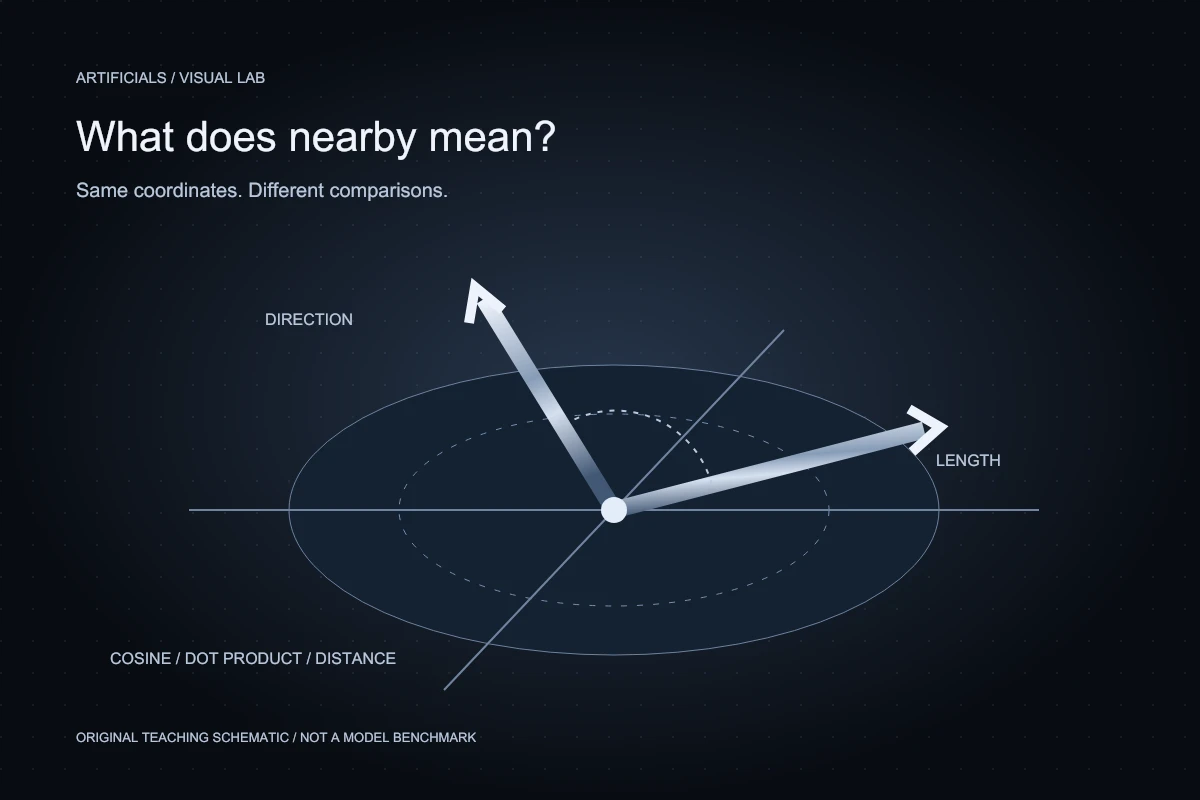 Guides · 8 min read
What does “nearby” mean? A visual lab for AI vector search
Rotate a vector and change the metric to see why rankings move.
Read the guide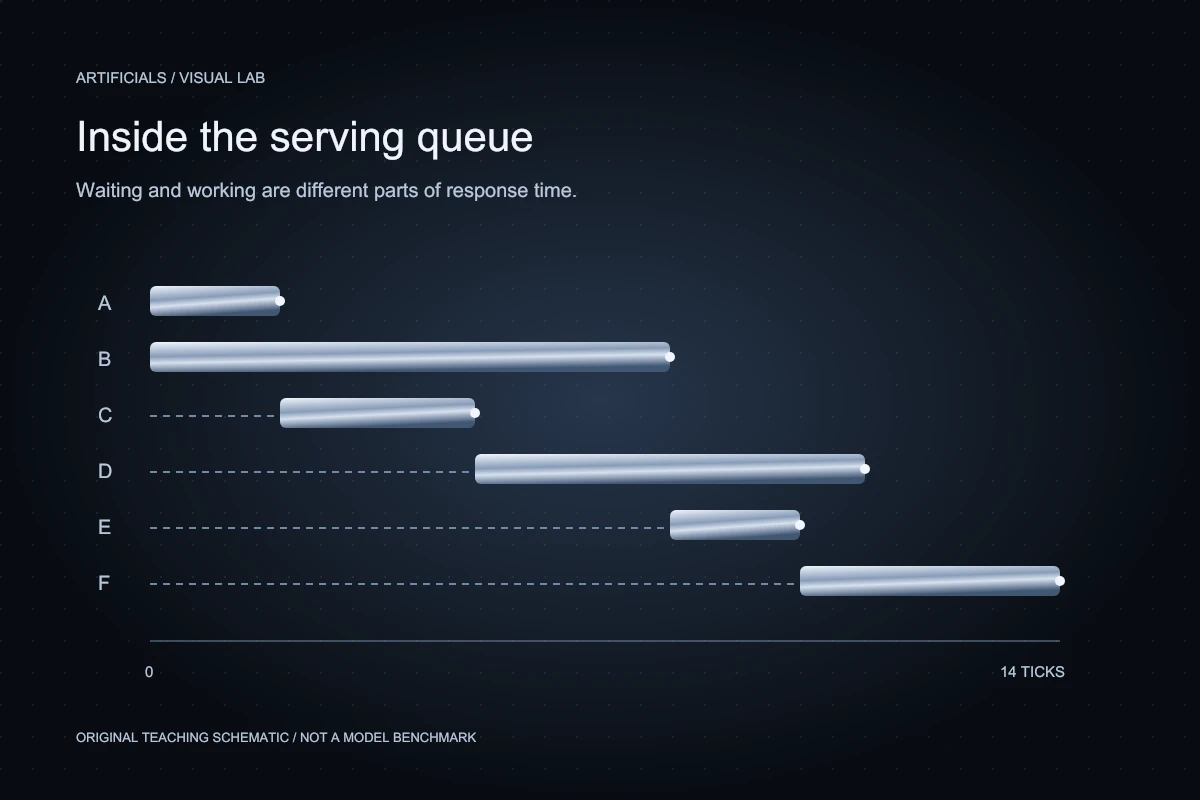 Engineering · 8 min read
Why a fast model can feel slow: inside the serving queue
Replay a queue and compare fixed batches with continuous admission.
Read the guide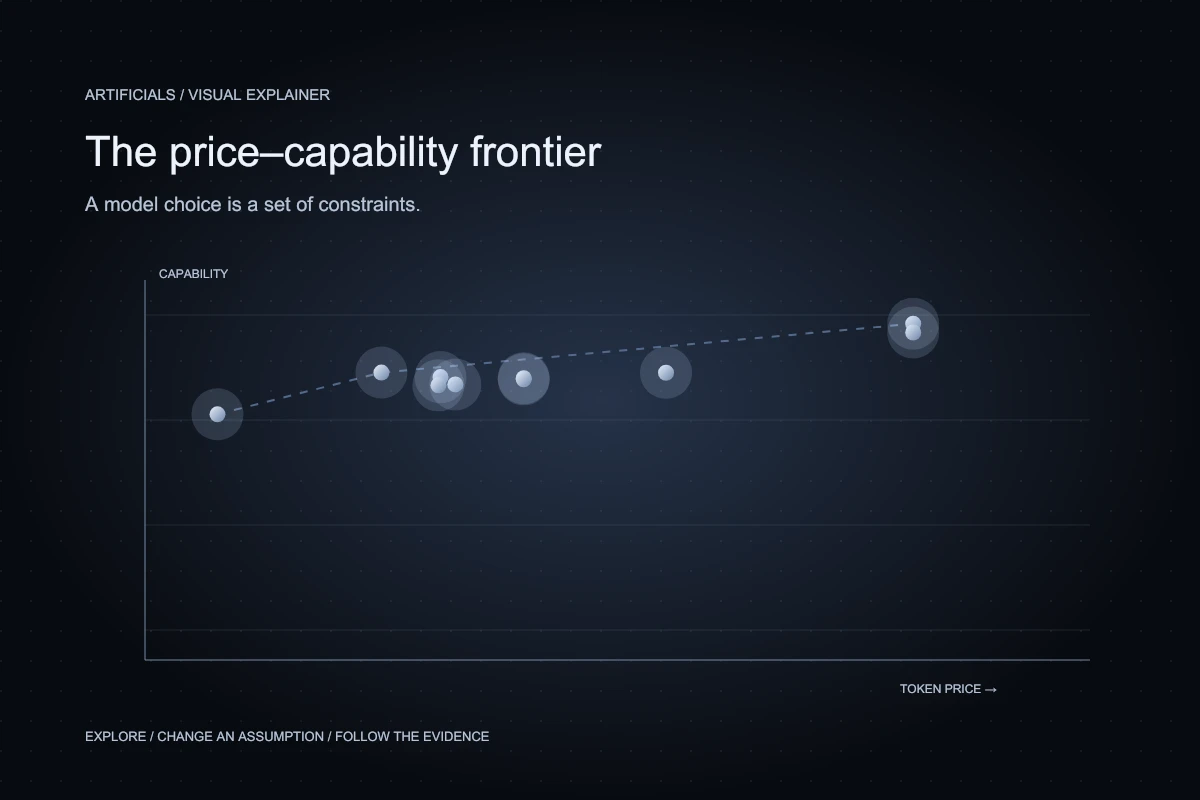 Guides · 8 min read
The price–capability frontier: choose a model with the chart open
Move the budget. Change the workload. Inspect the tradeoff.
Read the guide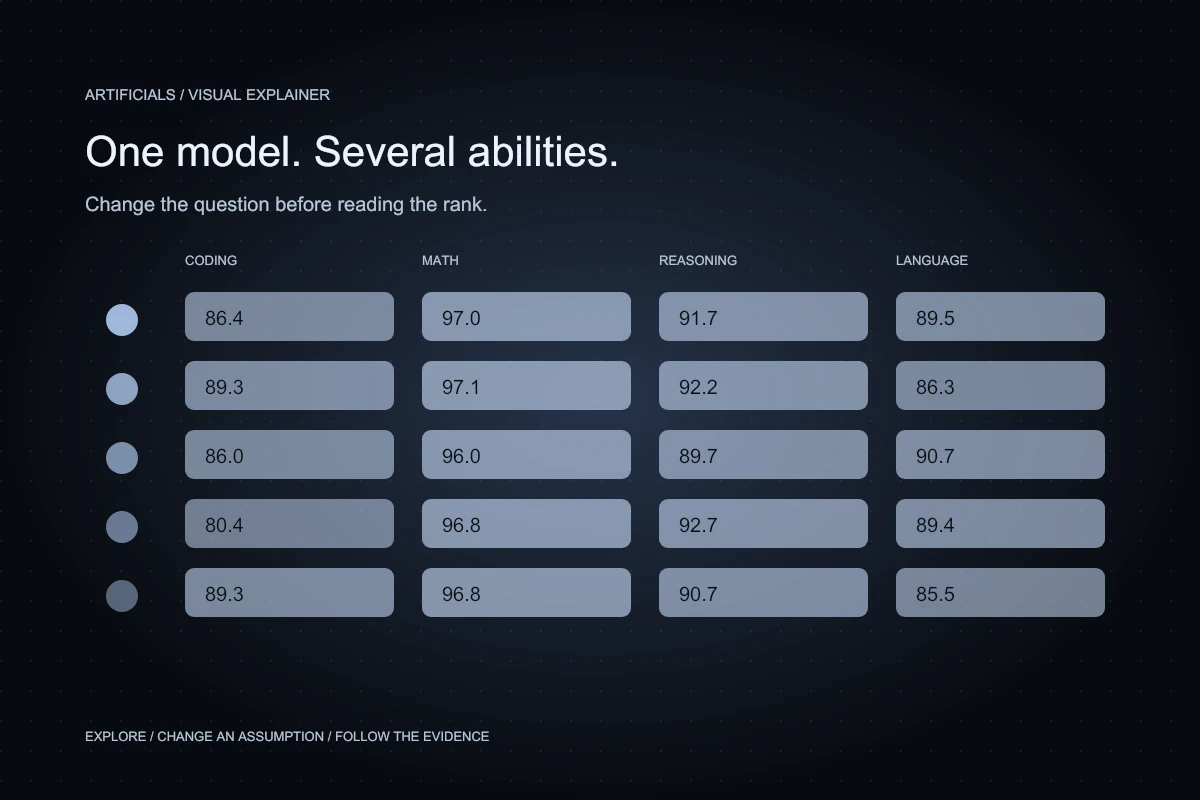 Research · 8 min read
A leaderboard has more than one winner
Switch skills and see why the ordering changes.
Read the guide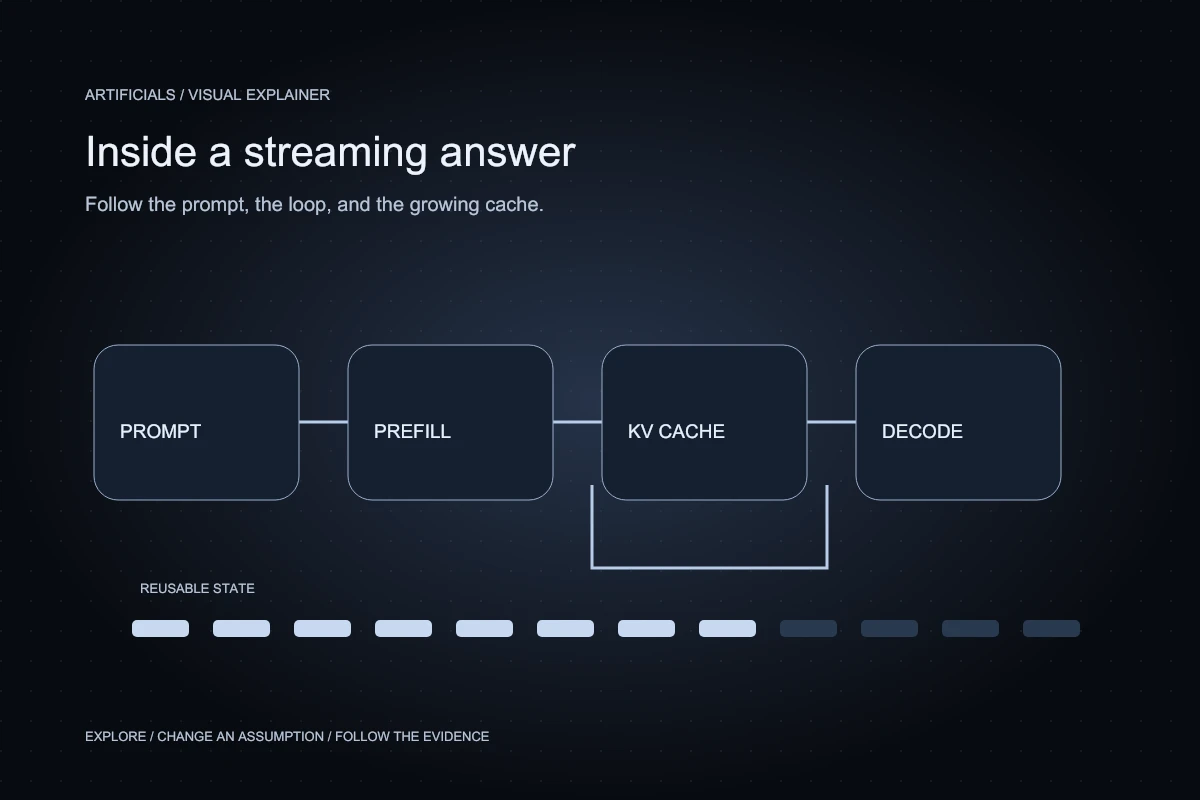 Engineering · 8 min read
Inside a streaming answer: prefill, decode, and the growing cache
Follow tokens through an animated inference pipeline.
Read the guide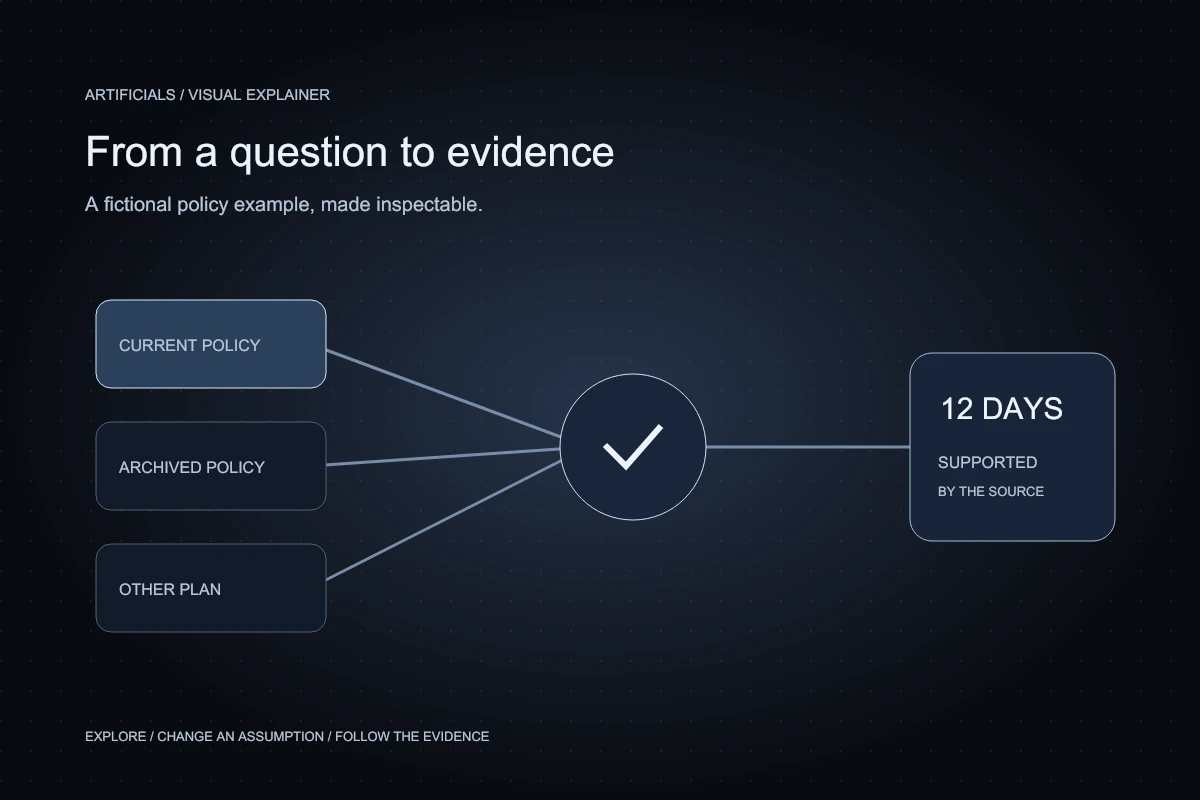 Engineering · 8 min read
From a question to evidence: watch a grounded answer take shape
Trace retrieval, inspect sources, and remove the evidence.
Read the guide Engineering · 8 min read
FlashAttention: why moving less data can make AI faster
Understand the memory traffic behind faster attention.
Read the guide AI models · 8 min read
Neural network pruning: fewer weights do not guarantee faster inference
Connect model sparsity to real deployment savings.
Read the guide AI models · 7 min read
Promptable segmentation: turn an outline into a useful image mask
Evaluate image masks, fine edges, and editing effort.
Read the guide Guides · 8 min read
Tabular AI: choose a model for the rows you actually have
Compare trees and neural networks on honest data splits.
Read the guide Research · 7 min read
Differential privacy in AI: define the protection before training
Understand privacy units, training noise, and accounting.
Read the guide Engineering · 7 min read
Approximate vector search: find useful neighbors without visiting every point
Balance vector-index recall, latency, and freshness.
Read the guide Research · 8 min read
Test-time adaptation: when an AI model changes while it is being used
Test online updates against drift, order, and recovery.
Read the guide AI models · 8 min read
Multi-task learning: when sharing a model helps and when tasks compete
Measure shared representations and conflicting objectives.
Read the guide AI models · 7 min read
Transformer attention: how a word changes meaning in context
How attention builds context, and what its weights cannot explain.
Read the guide AI models · 7 min read
Encoders, decoders, and language models: choose the right kind of understanding
Match encoder, decoder, and encoder-decoder designs to the task.
Read the guide Research · 7 min read
Contrastive learning: teaching a model what belongs together
Learn useful similarity without confusing a negative pair with a fact.
Read the guide AI models · 7 min read
Diffusion language models: generating text by revising the unknown
Explore iterative text generation, its constraints, and useful tests.
Read the guide Research · 7 min read
Verifiable rewards: what a reasoning model learns from being checked
Design checkers that reward correct work and expose missing coverage.
Read the guide Research · 7 min read
Reward hacking: when an AI system succeeds at the wrong objective
Find the gap between a rewarded metric and the outcome users need.
Read the guide Engineering · 7 min read
Computer-use agents: from reading a screen to completing a task safely
Build screen-based agents with verified actions and bounded recovery.
Read the guide Guides · 7 min read
AI search citations: a link is only the start of the evidence
Check whether a citation supports the claim, scope, and conditions.
Read the guide Engineering · 7 min read
OCR and document AI: recover the page before trusting the text
Preserve reading order, tables, and evidence when extracting documents.
Read the guide AI models · 7 min read
Vision-language-action models: when an AI answer has to move something
Connect instructions to robot actions with observable completion.
Read the guide Research · 7 min read
World models: useful imagined futures still need contact with reality
Use imagined futures while testing where learned dynamics go wrong.
Read the guide Research · 7 min read
Protein AI: a predicted structure is a starting point for investigation
Read predicted structures without confusing confidence with proof.
Read the guide Research · 7 min read
AI weather models: evaluate the forecast where decisions happen
Compare forecasts by location, lead time, uncertainty, and purpose.
Read the guide AI models · 7 min read
Training bigger AI models: balance parameters, data, and useful compute
Balance model capacity, data, and compute across the model's lifetime.
Read the guide Research · 7 min read
Sparse autoencoders: inspecting model features without inventing a mind
Inspect learned features while separating labels from causal evidence.
Read the guide Guides · 7 min read
AI text watermarks: what detection can and cannot establish
Understand watermark signals, error rates, and limits on authorship claims.
Read the guide Guides · 7 min read
AI translation: preserve terminology, intent, and the right uncertainty
Preserve terminology, conditions, and intent across languages.
Read the guide Engineering · 7 min read
Active learning: spend human labeling effort where it teaches the most
Choose useful examples to label and measure the value of human effort.
Read the guide Engineering · 7 min read
AI anomaly detection: turn unusual signals into useful alerts
Turn unusual measurements into alerts that support investigation.
Read the guide AI models · 7 min read
Continual learning: teach a model something new without losing the old job
Learn new tasks while testing and preserving earlier capabilities.
Read the guide AI models · 7 min read
Self-supervised audio: learning useful patterns before writing a transcript
Learn audio representations, then test what transfers to the real task.
Read the guide Engineering · 7 min read
Neural image compression: what a smaller file chooses to preserve
Compare compression by fidelity, file size, and the full decoding cost.
Read the guide Research · 7 min read
Causal machine learning: predicting an outcome is not predicting an intervention
Separate observed associations from evidence about interventions.
Read the guide Engineering · 7 min read
Model confidence calibration: make a probability useful for a decision
Test whether confidence scores support reliable routing decisions.
Read the guide AI models · 7 min read
Video understanding: ask what happened between the sampled frames
Preserve temporal evidence instead of guessing between sampled frames.
Read the guide Engineering · 7 min read
Data augmentation: change the example without changing the answer
Transform training examples while keeping their targets meaningful.
Read the guide Research · 7 min read
Neuro-symbolic AI: connect learned suggestions to rules that can be checked
Connect learned interpretations to explicit rules and scoped checks.
Read the guide AI models · 7 min read
Neural network optimizers: why the route matters as much as the destination
Diagnose learning rates, momentum, and update rules through experiments.
Read the guide AI models · 7 min read
Diffusion and flow matching: how image models turn noise into structure
Understand the generation process, separate architecture from product quality, and build a practical evaluation for images that must satisfy a real brief.
Read the guide AI models · 7 min read
State-space models: a different way to carry context through a sequence
Look beyond architecture slogans to understand recurrent state, selective memory, long-sequence tests, and the operational questions behind Mamba-style systems.
Read the guide Research · 7 min read
Time-series foundation models: forecast the future without leaking it
Design realistic forecasting evaluations with historical cutoffs, operational baselines, uncertainty, missing data, and a clear connection to the decision being made.
Read the guide AI models · 7 min read
Graph neural networks: learning from relationships without losing the problem
Decide when graph learning is useful by defining nodes, edges, time boundaries, baselines, and the evidence behind a prediction about connected data.
Read the guide Engineering · 7 min read
AI recommendations: cold starts, feedback loops, and useful discovery
Build recommendations around reader intent, meaningful feedback, and a fair opportunity for new content instead of treating clicks as the whole objective.
Read the guide Engineering · 7 min read
Training data lineage: know what entered the model before trusting what leaves
Create a traceable dataset release with source records, transformation history, duplicate handling, split boundaries, and a practical correction process.
Read the guide Engineering · 7 min read
AI code review: build an evidence trail before accepting the suggestion
Turn automated review into a useful engineering aid with reproducible findings, repository context, targeted tests, and clear ownership of the final decision.
Read the guide Guides · 8 min read
Document chunking: preserve meaning before optimizing retrieval
Design retrieval units that keep headings, exceptions, tables, and source identity intact, then evaluate whether the returned evidence can actually answer the question.
Read the guide AI models · 7 min read
Multimodal embeddings: search across pictures and words with clearer evidence
Understand shared representation spaces, visual relevance, hard negatives, and the separate roles of similarity, metadata, and verification in image search.
Read the guide Guides · 8 min read
AI summarization: preserve the numbers, exceptions, and uncertainty
Design summaries that remain faithful to source documents, with claim-level review, explicit omissions, numerical checks, and formats matched to the reader’s decision.
Read the guide Research · 7 min read
Conformal prediction: useful uncertainty with conditions attached
Learn what a prediction set can establish, why calibration data matters, and how to connect uncertainty estimates to a practical review workflow.
Read the guide Research · 7 min read
Federated learning: moving the training without pretending the data is risk-free
Explore distributed training through participant selection, update privacy, uneven data, communication costs, and realistic evaluation across sites.
Read the guide Research · 8 min read
Machine unlearning: why deleting a record does not erase a trained model
Separate source deletion, retrieval removal, output suppression, and model unlearning, then define the evidence needed to support a meaningful removal claim.
Read the guide Engineering · 7 min read
Training checkpoints: recovering the experiment, not just the weights
Plan model recovery with optimizer state, data position, configuration, integrity checks, and a restart drill that verifies what a saved checkpoint can actually restore.
Read the guide Guides · 8 min read
AI image descriptions: write for the reader and the task
Use AI to draft useful image descriptions while preserving context, uncertainty, functional meaning, and human review for complex visual information.
Read the guide Engineering · 7 min read
Batch AI pipelines: make a million small tasks observable and recoverable
Design asynchronous AI processing with durable job identity, bounded retries, output validation, selective replay, and quality checks before results are published.
Read the guide AI models · 4 min read
Mixture of experts: what active parameters actually tell you
Read sparse-model specifications with a clearer view of routing, memory, serving costs, and the evidence needed to choose a deployment.
Read the guide Engineering · 4 min read
The KV cache: why long conversations consume serving memory
Understand the difference between model weights and attention state, then design a capacity test that includes long prompts and concurrent users.
Read the guide AI models · 4 min read
Speculative decoding: when drafting ahead makes inference faster
A practical explanation of draft-and-verify generation, acceptance rates, and the workload measurements that determine whether it helps.
Read the guide AI models · 4 min read
LoRA adapters: a small training artifact with a larger release contract
Plan a useful adapter experiment, keep the base model and tokenizer aligned, and evaluate the operational work beyond a small download.
Read the guide Research · 4 min read
Preference optimization: what a preferred answer really teaches
Understand DPO through the quality of the comparisons it learns from, including hidden style shortcuts, disagreement, and independent evaluation.
Read the guide Guides · 4 min read
Multilingual AI: the hidden product effects of tokenization
Why identical character limits can create unequal experiences across languages, and how to test budgets, truncation, and quality fairly.
Read the guide AI models · 4 min read
Vision models: when more pixels help, and when the evidence is missing
Design image-input experiments that separate resolution, cropping, scene context, and unsupported inference in visual AI workflows.
Read the guide Guides · 4 min read
Image generation consistency: why a seed is not an art direction system
Build a repeatable image workflow with reference assets, invariant details, version records, and review at the sizes where images will be used.
Read the guide AI models · 4 min read
Evaluating AI video: inspect what happens between the best frames
Build a video review around identity, motion, causality, editability, and usable footage instead of judging only a striking still frame.
Read the guide Research · 4 min read
Speech recognition quality: what word error rate leaves out
Use word error rate alongside speaker attribution, critical facts, and correction effort to evaluate transcripts for real work.
Read the guide Engineering · 4 min read
Text-to-SQL assistants: make the question precise before running the query
Design database question answering around metric definitions, restricted execution, result validation, and clear limits on what an answer establishes.
Read the guide Engineering · 4 min read
Permission-aware RAG: retrieve only what the reader may know
Trace access control through indexing, retrieval, reranking, citations, caches, and deletion so an assistant respects document boundaries.
Read the guide Engineering · 4 min read
Agent memory needs correction, expiry, and deletion
Design persistent AI memory as an editable data lifecycle, with clear scope, evidence, conflict handling, and limits on what should be remembered.
Read the guide Engineering · 4 min read
AI tool retries: prevent a timeout from becoming a duplicate action
Use operation identities, durable state, reconciliation, and bounded retries when an agent calls tools that change the world.
Read the guide Industry · 4 min read
MCP connections: interoperability does not remove trust boundaries
Review an AI tool connection by its permissions, data flow, server behavior, and recovery path instead of treating protocol support as a security verdict.
Read the guide Research · 4 min read
Benchmark contamination: ask what the score can still establish
Distinguish possible training overlap from demonstrated leakage, then build an evaluation whose conclusions survive scrutiny.
Read the guide Research · 4 min read
AI rankings and uncertainty: a narrow lead is not a universal win
Read pairwise preferences, confidence intervals, sample composition, and practical significance before turning a leaderboard into a buying decision.
Read the guide Industry · 4 min read
AI energy claims: measure a useful task before comparing footprints
Distinguish power from energy, define the measurement boundary, and include retries and quality when comparing AI inference workloads.
Read the guide Engineering · 4 min read
Browser-based AI: the first download is part of the experience
Evaluate local inference through download size, device capability, responsiveness, storage, and the actual data paths that determine privacy.
Read the guide Engineering · 4 min read
AI agent observability: trace the work without recording everything
Connect model calls, tools, retries, and validation outcomes in a useful trace while minimizing sensitive content and misleading success metrics.
Read the guide AI models · 8 min read
Reasoning models: when extra thinking earns its cost
A practical look at reasoning workloads, inference budgets, verification, and measuring whether additional computation improves the finished task.
Read the guide Engineering · 8 min read
Changing embedding models without breaking your search
Follow an embedding migration from relevance judgments and index design to backfills, permission checks, shadow queries, cutover, and rollback.
Read the guideIndustry · 8 min readHow to ship an AI model upgrade without losing trust
Design a model release process around behavior contracts, paired evaluations, read-only shadowing, controlled rollout, and a rollback that actually works.
Read the guideEngineering · 9 min readVoice AI that listens: turn-taking, latency, and recovery
Explore the full voice interaction loop, from microphone input and transcript revisions to interruptions, action confirmation, accessibility, and realistic evaluation.
Read the guideAI models · 9 min readSmall language models and distillation: build for a defined job
Examine when a compact model makes sense, how teacher-generated examples can help, and how to evaluate the resulting system without inheriting hidden mistakes.
Read the guide Research · 9 min read
Synthetic data for AI: useful coverage without false confidence
Design a synthetic-data pipeline with a clear purpose, independent labels, provenance, diversity checks, real-data evaluation, and explicit limits on what the results prove.
Read the guideAI models · 3 min readHow to choose an AI model for your product
Turn a crowded model shortlist into a practical decision using task contracts, failure costs, and a repeatable comparison.
Read the guideAI models · 3 min readEvaluating coding models beyond a leaderboard
Compare AI coding assistants on repository tasks, independent tests, review effort, and the reliability of the final patch.
Read the guideAI models · 3 min readRAG vs. fine-tuning: diagnose the problem first
Distinguish missing knowledge from inconsistent behavior before choosing retrieval, fine-tuning, or a simpler application change.
Read the guideEngineering · 3 min readBetter RAG starts with retrieval you can inspect
Learn where keyword search, embeddings, reranking, and document permissions fit in a grounded answer pipeline.
Read the guideIndustry · 3 min readOpen-weight models vs. hosted APIs: the operating decision
Compare control, infrastructure, maintenance, and workload shape before deciding where an AI model should run.
Read the guideAI models · 3 min readQuantization explained: what fits is not always what works
Understand model weight precision, runtime memory, and the quality checks needed before deploying a smaller model artifact.
Read the guideEngineering · 3 min readStructured output is the beginning of validation
JSON schemas help software read model responses. Business rules, evidence checks, and authorization still decide whether those responses are usable.
Read the guideEngineering · 3 min readWhen does your product need an AI agent?
Decide whether a fixed workflow or a model-directed loop fits the task, then define tools, stopping conditions, and recovery paths.
Read the guideEngineering · 3 min readPrompt injection: design the boundary around the model
Understand why retrieved text can become an instruction risk and how narrow tools, permissions, and evidence handling reduce the impact.
Read the guideGuides · 3 min readHow to evaluate an image model for real design work
Assess composition, instruction following, editability, and usable output rate instead of choosing a model from one impressive sample.
Read the guideAI models · 3 min readMultimodal AI for documents: test the whole page
Build a document evaluation that checks visual detail, layout, extraction accuracy, and what happens when the evidence is unreadable.
Read the guideResearch · 3 min readBuild an AI evaluation set you can trust
Collect representative cases, prevent leakage, and keep development examples separate from the evidence used to approve a release.
Read the guideResearch · 3 min readLLM as a judge: useful reviewer, imperfect measurement
Design model-based grading with explicit rubrics, position checks, human calibration, and deterministic checks where they fit.
Read the guideResearch · 3 min readWhen should an AI system say “I don’t know”?
Separate confident language from calibrated evidence, then design an abstention path that balances useful coverage and costly errors.
Read the guideEngineering · 3 min readModel routing: lower cost without hiding quality failures
Use measurable task categories, bounded escalation, and explicit fallback rules to decide which model should handle each request.
Read the guideEngineering · 3 min readAI caching without stale or cross-user answers
Separate context caching from answer caching, then design cache keys, invalidation, and permission checks around the underlying data.
Read the guideResearch · 1 min readA benchmark is a signal. Read the context.
Model scores become useful when you understand the task, evaluation method, and tradeoffs behind them.
Read the guideAI models · 1 min readMore context. Better answers? It depends.
A larger context window can hold more information. Retrieval quality and careful task design still matter.
Read the guideGuides · 1 min readUnderstand the cost behind a prompt.
Input, output, context, and repeated requests all affect an AI application’s running costs.
Read the guideEngineering · 1 min readFast AI is more than tokens per second.
The first visible response, total completion time, and the quality of the finished task measure different things.
Read the guideEngineering · 1 min readFrom a generated interface to a real application.
Authentication, a server API, and persistent data turn a visual prototype into an application people can use.
Read the guide